- Current Events Democrats Respond to the President’s State of the Union
- Elections The Election Question: To Centralize or Not to Centralize
- Elections Who Will Be Iowa’s Next Governor?
- Current Events A History of the NATO Alliance
- Current Events Some Face Rising Health Care Costs
- Current Events Litigating the Separation of Powers
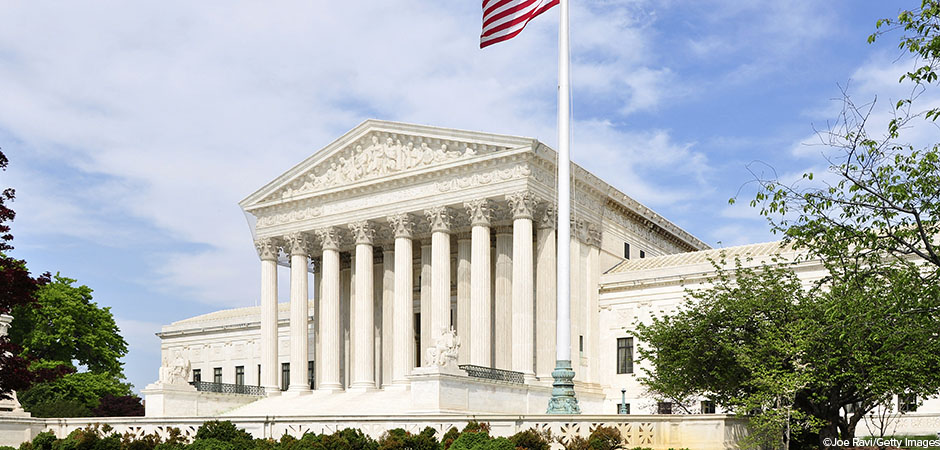
Litigating the Separation of Powers
You’ve learned in your social studies classes that there are three branches of the federal government: executive, legislative, and judicial. Each branch of government has its own powers and responsibilities. This “separation of powers,” which is defined in the U.S. Constitution, prevents any one branch from becoming too powerful.
The U.S. Supreme Court is considering a case that could shift that balance of power, giving more power to the executive branch. Here, Election Central takes a closer look at this case.
The Case
The case under consideration concerns Rebecca Kelly Slaughter, who serves on the Federal Trade Commission. The Federal Trade Commission (FTC) is an independent, bipartisan agency, created by Congress in 1914. The FTC protects fair economic competition. No more than three members of the five-member body can be from the same political party. Rebecca Slaughter is a member of the Democratic Party. She was appointed to the FTC by President Trump during his first term in 2018. Slaughter was later re-appointed by President Biden to a term that is scheduled to end in 2029. However, in March 2025, the Trump administration sent Slaughter an email saying that she was fired because her work didn’t line up with the administration’s priorities.
Members of the FTC can only be fired for poor performance at their job. Because Slaughter had no history of poor performance, she sued. A lower court determined that she should not have been fired and reinstated her job. The Trump administration then appealed that court’s decision. The Supreme Court heard the details of the case and ruled in favor of the Trump administration. Slaughter lost her job at the FTC.
History Repeating Itself?
This is not the first time there has been debate on whether a president can remove a member of an independent commission. In a similar 1933 case, President Franklin D. Roosevelt also tried to fire a member of the FTC with whom he didn’t agree politically. That time, the Supreme Court ruled against the president. It stated that the FTC is an independent agency, so the president doesn’t have the power to fire members. This 1935 case was called Humphrey’s Executor.
During Donald Trump’s first term as president, the Supreme Court allowed him to fire a member of a different independent agency–the Consumer Financial Protection Bureau. According to the Supreme Court, Humphrey’s Executor isn’t relevant anymore because the Federal Trade Commission has far more power than it had in 1935. Since then, Trump has also fired members of other independent agencies, such as the Equal Opportunity Commission (EEOC) and the National Labor Relations Board (NLRB).
Why Does This Matter?
The Slaughter case is significant because independent agencies such as the FTC are intended to operate independently of partisan goals. If the president is permitted to fire board members based solely on political disagreement, it gives the president power over those boards. Those who oppose the Supreme Court’s ruling against Rebecca Slaughter say that this threatens the ability of the boards to carry out their work in a nonpartisan way. They believe that these boards should remain independent to preserve the balance of powers of the federal government.
Those who agree with the Supreme Court’s ruling, support something known as the “unitary executive theory.” This idea states that the president should have complete control over the executive branch, including independent boards that work within it. Laws that restrict the president’s right to fire any member of those boards (such as Humphrey’s Executor) are unconstitutional in the first place.
In January 2026, the Supreme Court will hear another, similar case that is also based on Humphrey’s Executor: Trump’s attempted firing of Lisa Cook, the Federal Reserve Governor.
What Do You Think? Imagine that you are a U.S. Supreme Court Justice evaluating the case of Trump v. Slaughter. Would you vote in favor of the Trump administration, or in favor of Rebecca Kelly Slaughter? Why?