- Current Events SCOTUS and Artificial Intelligence
- Current Events Democrats Respond to the President’s State of the Union
- Elections The Election Question: To Centralize or Not to Centralize
- Elections Who Will Be Iowa’s Next Governor?
- Current Events A History of the NATO Alliance
- Current Events Some Face Rising Health Care Costs
A History of the NATO Alliance
Several times during his first year back in the White House, President Trump expressed a desire to acquire Greenland. More than once the president suggested that the U.S. could use its military to take control of the nation, which is a territory of Denmark. Denmark and the United States are both members of the North Atlantic Treaty Organization (NATO), which has united many countries in the decades following World War II.
In recent days, the president has tried to negotiate more U.S. military presence in Greenland without the threats of using force. But these events have brought the history of the NATO alliance into the news spotlight. What exactly is NATO, and why is this alliance important?
A Brief History of NATO
The North Atlantic Treaty Organization was founded in 1949 following World War II. Its goal was to repair the political damage of the war while trying to prevent something like it from happening again. The countries that formed the NATO alliance were also concerned about resisting the expanding power of the Communist-run Soviet Union.
World War II left a path of incredible devastation across Europe. About 35.5 million Europeans were killed in the war. Nineteen million of them were civilians, and hundreds of thousands of people were left orphaned or homeless. Meanwhile, the Soviet Union was aiding Communist uprisings across the continent. Rebuilding and moving forward couldn’t begin until European nations started to trust one another again.
The NATO alliance was born under these global circumstances. The North Atlantic Treaty was signed on April 4, 1949. The member nations laid out a foundation for military cooperation between them. It stated that if one of the countries were attacked, it would be viewed as an attack on all of them (Article 5 of the treaty). The original twelve members of this alliance were Belgium, Canada, Denmark, France, Great Britain, Iceland, Italy, Luxembourg, the Netherlands, Norway, Portugal, and the United States. Greece and Turkey joined soon after in 1952, and West Germany in 1955.
In response to the NATO alliance, the Soviet Union formed the Warsaw Pact with its allies in Eastern Europe. The competing alliances served to establish the decades of the post-World War II Cold War. These nations avoided direct military conflicts with one another, in part because of the fear that attacks on an allied member could grow into a devastating nuclear conflict.
When the Berlin Wall that separated the communist East Berlin from the democratic West Berlin fell in 1989, the decades of Cold War began to end. NATO eventually accepted a reunited Germany into its alliance. After the Soviet Union disbanded in 1991, several more formerly Soviet-controlled countries joined NATO in the years that followed.
NATO in the Modern World
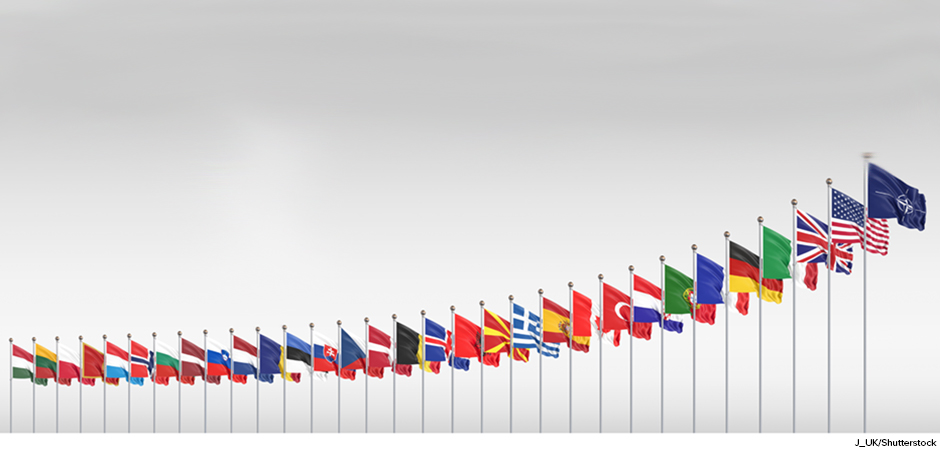
Today, NATO consists of 32 democratic member nations and has been a strong source of American diplomacy in Europe and across the globe. After the terrorist attacks of September 11, 2001, NATO invoked Article 5 of the Treaty, which states that an attack on one member nation is an attack on all. Therefore, several NATO nations joined the United States in invading Afghanistan, which was the home base of al-Qaida, the terrorist group responsible for the attacks.
But in today’s complicated world, military alliances alone aren’t enough to successfully maintain peace. Therefore, in 2010, NATO member nations agreed to a Strategic Concept that committed the alliance to working together before, during, and after any international crisis. Today’s NATO focuses on preserving peace and stability through crisis management operations around the globe. An updated Strategic Concept in 2022 reaffirmed NATO’s commitment to its three core tasks: deterrence and defense; crisis prevention and management; and cooperative security among member nations.
Dig Deeper What 32 democratic nations are members of NATO today? Use Internet resources to find out. How does this list compare to the original 1949 alliance?